Wood and sound
The human ear registers sound from the vibration of elastic bodies at frequencies between 15 and 24000 Hz; below and above that range lie infrasound and ultrasound respectively. For the ear to hear a sound, there has to be an elastic medium between the vibrating source and the ear to carry the vibrations. That medium can be anything: air, water, metal or wood. In wood's case, its uneven — more precisely, anisotropic — structure makes it irreplaceable in the making of musical instruments.

Speed of sound propagation
In solids it is given by:

where E = modulus of elasticity, ρ = density, or mass per unit volume.
Because wood is not homogeneous, sound waves travel through it at different speeds depending on whether they run parallel or perpendicular to the fibres. Taking ρ as constant, though, we can work out the ratio between the speed along the fibres and the speed across them:
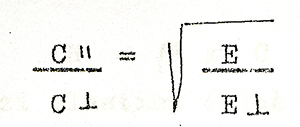
Work out these ratios — or, more quickly, look them up in tables where they are already given per sample — and you will see that sound travels along the fibres at roughly the same order of magnitude as in metals, while across them it is far slower.
Many factors affect this speed in wood: in saturated wood, moisture slows it by about 20%, and temperature has a considerable effect too.
Damping of the vibratory motion
Plot the displacements of a vibrating body over time and you get the sine curve typical of harmonic motion. With nothing further to sustain it, the vibration dies away and its amplitude shrinks; in practice the energy is lost to friction and radiated as sound into the surrounding fluid. Radiation damping is given by the ratio between the speed of sound in a material and its density:
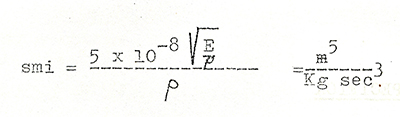
where E = modulus of elasticity, ρ = density.
To picture friction damping, take the initial amplitude A1 of the vibrations, dropping to A2 on the second cycle; friction damping is the natural logarithm of the ratio A1/A2.
Q is the ratio between the frequency f and the frequency interval Δ between the two points on the resonance curve where the amplitude falls to 1/√2 of the maximum. In practice Q, the resonance coefficient, is (thankfully) already tabulated. In musical instruments you want wood with modest internal friction but high radiation. Moisture content matters just as much to the damping figures — it raises them — as does coating the wood with lacquers and varnishes, which sharply increases the logarithmic decay.
Specific acoustic resistance
Much as a radio-electrical device has ohmic resistance, wood too — like any elastic medium — resists anything that tries to set it oscillating. This resistance is the product of the density ρ and the speed of propagation (C).
R = ρ × C
Given two elastic media (that is, media that can oscillate) A and B, the power that sets A oscillating is partly passed on to B, partly reflected, and partly absorbed and turned into heat through friction and deformation — producing damping effects that grow with frequency.
Worth noting: when the two media's acoustic resistances differ markedly, reflection dominates; when they are similar, transmission is favoured. Wood happens to have low acoustic resistance and therefore strong radiation — qualities heightened in woods such as the conifers, with their very regular structure and thin, evenly spaced rings.