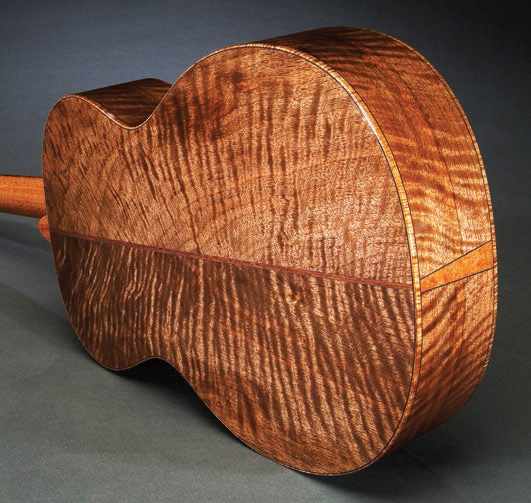
Whereas the great majority of soundboard woods — spruce, cedar, red spruce — come from closely related trees, the woods used for back and sides come from a far wider range of species, and so vary far more in look and sound.

Unlike the soundboard, a guitar's back and sides do not carry the structural load of the string tension, so almost any wood that will bend can be used. Back and sides lend the guitar's sound a certain colour, being surfaces that reflect the vibrations the strings set in motion. That is why they are usually dense, hard woods, unlike the porous, light soundboard woods such as spruce.
In this article we look at the woods traditionally used for the back and sides of guitars — acoustics above all — and at the tonal qualities each brings to the instrument.
The hardwood rule
For all their variety, the species used for back and sides have one thing in common: they are hardwoods.
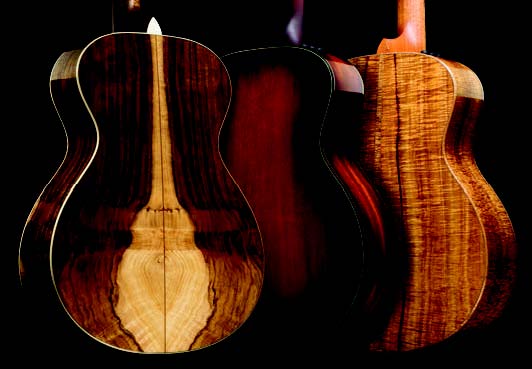
In North America we tend to assume hardwoods come from broadleaf trees while conifers like spruce and cedar come from evergreens — but in a tropical forest most plants are evergreen, and even some North American hardwoods, such as myrtle, are evergreen. To muddy things further, the "hardwood" and "softwood" categories overlap in all sorts of ways. Balsa, technically a hardwood, can be cut with a thumbnail, while some softwoods such as spruce and yew are quite awkward to produce.
To keep it simple, think of back and sides woods as coming from trees with leaves, and top woods as coming from trees with needles.
A flowering of tonewoods
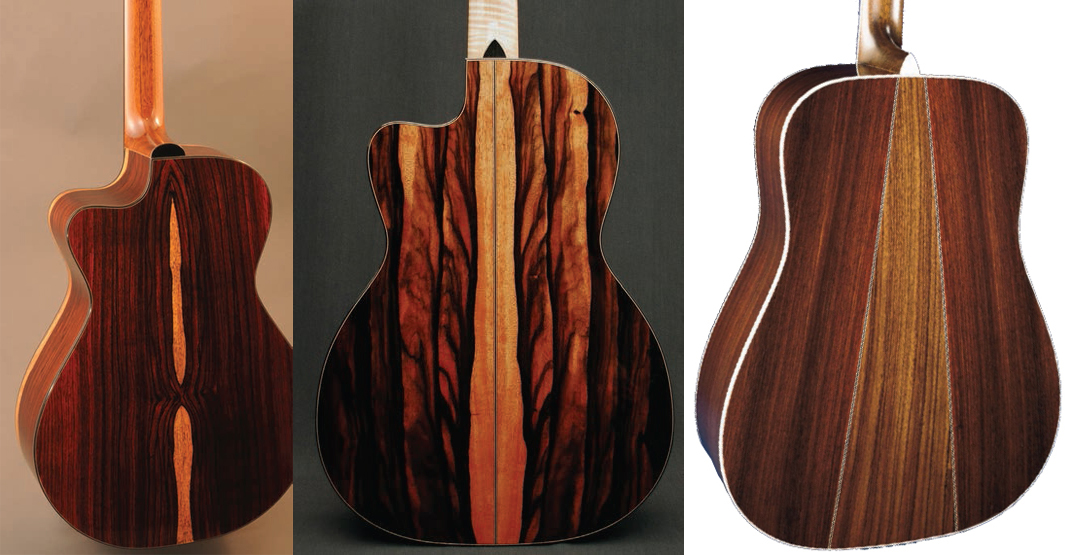
As recently as 1980 you could count the woods used for guitar back and sides on one hand: mahogany, rosewood and maple, and — at a stretch — koa, though it went into only a tiny share of the instruments built by North American companies; walnut, too, turned up now and then in small workshops and with individual builders. But the last 20 years have seen an explosion in the lutherie-wood market: individual builders went looking for new species to set themselves apart from the big manufacturers, widening their own range and offering their most loyal customers more to choose from. Much of that search, into tropical hardwoods, was driven by the need for good alternatives to endangered woods such as Brazilian rosewood.
Many of the lesser-known species that have caught on lately were discovered by woodworkers at large rather than by luthiers. Most furniture woods can be used for musical instruments; indeed the use of fine woods such as mahogany, rosewood, walnut and maple predates the first guitars. Some less exotic woods were no real discovery — a shift in the guitar world simply put them in the spotlight. Cocobolo (Dalbergia retusa) has long been known as a very colourful, hard, fine-sounding rosewood, but for decades it was avoided because its dust caused allergic reactions in many in the trade. With the environmental troubles around Brazilian and Madagascar rosewood (both endangered) and better dust-collection systems, cocobolo became a sound alternative to the far more available Indian rosewood (East Indian rosewood — Dalbergia latifolia). "Australian blackwood" (Acacia melanoxylon, also called black acacia for its bark) had been known as an excellent wood for fretted instruments for years, but there was no reason to reach for it while its far better-known cousin, Hawaiian koa (Acacia koa), was plentiful and relatively cheap. Then strong demand, shrinking stocks and gorgeously figured sets pushed koa up to the price of Brazilian rosewood — and Australian acacia rose in popularity as a result.
Visual variety
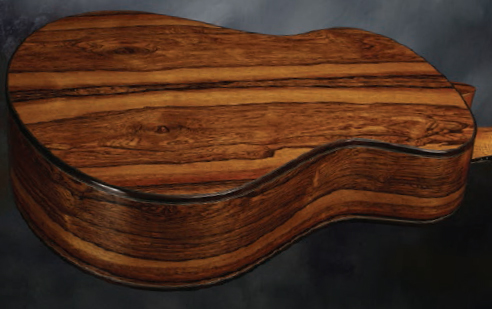
The appetite for greater visual variety is another reason an ever-wider range of woods found their way onto guitar backs and sides. Many players still wanted straight-grained quarter cuts (like the ones used in the good old days), but the share of buyers who insisted on even colour and straight grain — especially on expensive guitars — fell. Bubinga, sometimes called "African rosewood" (even though Didelotia africana is not in the Dalbergia family), is a fine example of a dense, fairly heavy wood that makes great-sounding guitars — yet people spend far more time talking about its figure. Thanks partly to its interlocked grain, bubinga often shows contrasting facets that catch the light and give the wood a sense of movement. "Waterfall Bubinga" is now a recognised term, much like "Fiddleback maple", and the popularity of such eye-catching woods has led many luthiers, in order to draw attention to their instruments, to lean on the natural beauty of the back and sides rather than on inlays and decoration. Bubinga and other exotics with unusual figure are sometimes called "chatoyant", a word once reserved for gemstones that change colour as you turn them to the light. Another sign that strong visual contrast was mattering more than it used to is the appearance of sapwood, often down the centre of the back or even at the edges. The sapwood-heartwood contrast may now look striking, but years ago sapwood was cut away as unfit for a high-end guitar.
Compare apples to apples

Describing how hard and dense these new woods are is relatively easy. South American mahogany, for instance, is about 25% lighter than Indian rosewood but only a third stronger. Yet the moment you ask how something actually sounds, the obvious question is: compared to what? Many players have a fairly firm idea of how mahogany guitars sound next to rosewood ones, partly because companies like Martin & Co. have given us reference points for decades. Compare models of the same era — the D-18 and 000-18 (mahogany) against the D-28 and 000-28 (rosewood) — and you can hear the tonal difference between the two woods. Thanks to Taylor and Larrivée too, comparisons like these are possible, between maple and mahogany or rosewood. With production this consistent, especially within a given year or period, the back and sides can be treated as the main variable between the instruments.
That main variable is the key point when choosing the woods for an instrument you mean to buy, whoever the builder or brand. To get a reliable feel for how different woods sound, you have to compare guitars that are identical but for the back and sides. Comparing a small body in Indian rosewood with a dreadnought in mahogany tells you little, because the two instruments are so different. Compare two Taylor GAs — one with mahogany back and sides and a cedar top, the other with Indian rosewood back and sides and a Sitka top — and you will not be able to tell mahogany from rosewood, because the soundboard has changed too. Comparing guitars across brands leaves you even more at sea, since the models use different bracing and other design choices that shape the sound. And do not underestimate the difference the player makes: two guitarists using the same pick will still produce different sounds.
Once you step past the traditional species used for decades, comparing sound gets hard. Are you really going to hunt down two similar guitars from the same maker, one in African Blackwood and one in cocobolo? Probably not — but take comfort in the fact that both are true rosewoods (same family, Dalbergia) and both heavier than most of their kin. Different as they look, they sound very much alike, even though African Blackwood is denser still than cocobolo. The same goes for koa and Australian acacia (Australian Blackwood), both acacias with similar density and grain.
Comparing wood families
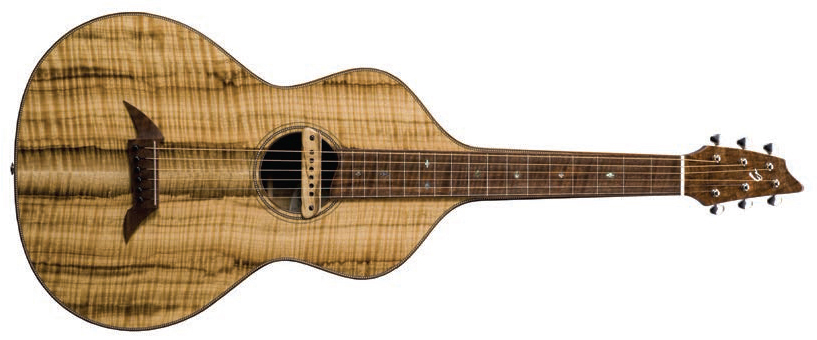
Working through the list of back and sides woods, I will offer some guidance on what to expect from each and how it can shape a guitar's sound. For the comparison, assume a spruce soundboard. Bear in mind that some woods, by their acoustic behaviour, fall into two or more groups. The point is not that bubinga and ziricote sound like rosewood, but that they share as much with rosewood as with mahogany or maple.
For some of these woods comparison is difficult, since so few guitars are built entirely from them. Will a parlor guitar in "black Sassafras" give you the sound you have always wanted? Or a dreadnought in Higuerilla? It may make sense to buy a guitar in one of these woods after trying one, then have it built to work for you. But ordering a custom guitar in a wood you do not know is an act of faith, all the more so if you have never tried the luthier's other instruments. Remember that every recommendation you read — about the wood, or about the fine and honest luthier who will use it — only holds up once you accept that the maker will build with their own hands and their own ears, not yours.
Rosewoods and similar woods
Taken as a group, rosewood guitars have a sound rich in reverberation, with many shades and plenty of sustain. The notes fuse into the chord; the effect is subtler on smaller-bodied guitars and clearest on larger, deeper formats such as dreadnoughts. If you love a dark, "chimey" sound, you probably love rosewood guitars. The downside, especially on big guitars, is that a long, lingering sustain in the low notes can bury the trebles.
The woods here span a wide tonal range, but they have much in common: they grow in the tropics, they are stiff, and the wood is dense and rich in natural oils and resins.
Brazilian rosewood (Dalbergia nigra) is the most famous rosewood. It has been listed as endangered for many years, and trade in the raw wood and in objects containing it is heavily restricted internationally.
Indian rosewood (Dalbergia latifolia), as the name says, comes from eastern India. It is the rosewood most used by the guitar industry.
Madagascar rosewood (Dalbergia greveana; other Dalbergia species from Madagascar go by the same name and have similar properties). Once put forward as a better alternative to Brazilian rosewood, it is now itself considered endangered, and most builders will no longer be able to restock it.
Cocobolo (Dalbergia retusa) comes from southern Mexico and Central America. Harder and heavier still than Brazilian rosewood, and often very colourful, cocobolo is now the luthier's best pick among the rosewoods.
Bubinga (Guibourtia demeusei), also called African rosewood, comes from West Africa. More than one species with similar traits is sold as bubinga.

Other rosewood-type woods
- African Blackwood (Dalbergia melanoxylon) from central and eastern Africa.
- African rosewood (see bubinga).
- Amazon rosewood (Dalbergia spruceana) from South America.
- Bloodwood (Brosimum rubescens) from South America, usually the Amazon basin.
- Bocote (Cordia gerascanthus) from North and Central South America.
- Burmese rosewood (see Southeast Asian rosewood).
- Camatillo rosewood, also known as "mexican kingwood" (Dalbergia congestiflora) from Mexico and Central America.
- Granadillo (Platymiscium yucatanum) from South America.
- Honduras rosewood (Dalbergia stevensonii) from Central America.
- Macassar ebony (Diospyros celebica) from Indonesia.
- Malaysian blackwood (Diospyros ebonasea) from Malaysia.
- Morado (see Pau Ferro).
- Narra (Pterocarpus indicus) from Southeast Asia, Indonesia and Malaysia. Narra is also known as Asian padauk.
- Ovangkol (Guibourtia ehie) from West Africa.
- Padauk (Pterocarpus soyauxii) from central and western Africa.
- Palo Escrito (Dalbergia paloescrito) from Mexico, a true rosewood but lighter, so closer in quality to mahogany.
- Pau Ferro (Machaerium villosum), also called Morado and Bolivian rosewood, from South America.
- Southeast Asian rosewood (Dalbergia bariensis) from across a wide area of Southeast Asia, also called Burmese rosewood.
- Wenge (Millettia laurentii) from central and western Africa.
- Zebrano (Microberlinia brazzavillensis) from West Africa.
- Ziricote (Cordia dodecandra) from Mexico and Central America.
Maple and similar woods

Maple is not a big share of "flat-top" guitar building, but it holds a near-monopoly on "Archtop" guitars and mandolins. European maple utterly dominates the building of bowed instruments.
Expect a strong emphasis on the fundamentals from a maple guitar, without the deep bass of rosewood or the sparkling highs of mahogany. Well suited to rhythm players, maple gives a very clean, more percussive sound, with less need to damp the strings to cut the sustain.
You can see why rhythm guitarists, hammering out tight patterns on closed chords, favour maple guitars. With little sustain and few harmonics, they are a smart choice for anyone stepping onto a stage to play loud: with maple back and sides, they are less prone to feedback.
- European Maple (Acer pseudoplatanus), from various parts of Europe, is the priciest maple for guitar building.
- Eastern Maple (Acer saccharum) from the eastern United States. This is the species that gives us maple sugar; birdseye maple is a natural variant of it. American archtop builders of the jazz age, such as Gibson and Epiphone, relied on this maple.
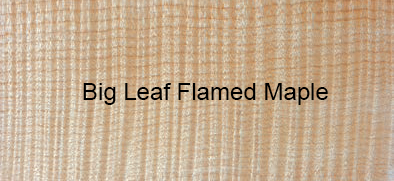
- Big Leaf Western Maple "Big Leaf Maple" (Acer macrophyllum) from North America. Quilted maple is this same species.
- Black Sassafras (Atherosperma moschatum) from Tasmania, an evergreen.
- Cherry (Prunus serotina) from the eastern and Midwestern USA.
- Myrtle (Umbellularia californica) from Oregon and California, also known as California laurel. Evergreen.
- Tasmanian myrtle (Nothofagus cunninghamii) from Tasmania; similar species also grow in Australia.
Mahogany and similar woods

Mahogany guitars have a brighter sound and a leaner tonal response. Players who prefer rosewood often find mahogany guitars short on harmonic complexity, especially in chords, but mahogany's clarity is much loved by musicians who play fast solos or runs, such as bluegrass guitarists. The mahogany group should probably take in many other woods, but "genuine mahogany", strictly speaking, is the South American one; pinning a well-defined tone on mahogany is famously hard, precisely because of the range of species involved, as with rosewood. In general, though, these woods give a bright, balanced sound even in deep-bodied guitars. On smaller guitars, however, many players miss the depth of bass you get from rosewood.
Mahogany, Honduras (Swietenia macrophylla), from southern Mexico down to the centre of South America, is also called "genuine mahogany" and "big-leaf mahogany". In the early 1920s mahogany was also used for the soundboards of many acoustic guitars.
Sapele (Entandrophragma cylindricum), from Africa, is also called African mahogany. Widely used as a stand-in for South American "big-leaf" mahogany, sapele is at once harder and heavier.
Other mahogany-type woods
- Higuerilla (Micrandra spruceana) from Peru.
- Ishpingo (Amburana cearensis) from Peru.
- Lacewood (Roupala brasiliensis) from South America.
- Machiche (Andira inermis); other species may go by this name. From southern Mexico and northern South America.
- African mahogany (see Sapele).
- Sipo (Entandrophragma utile) from Africa, similar to Sapele.
More back and sides woods
Acacias
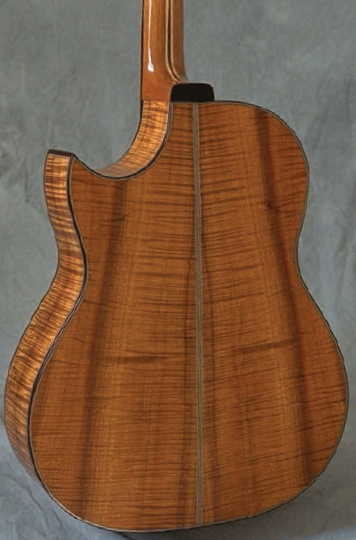
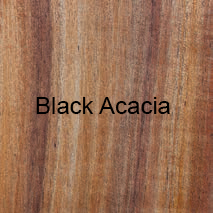
Black acacia (Acacia melanoxylon), often called Australian Blackwood, can be grown in Northern California, Africa and India, but most comes from Australia.
More of a class of its own is koa (Acacia koa) from Hawaii; many guitars have koa soundboards too. If you want to rile a koa lover, just say it sounds like mahogany or like rosewood. It is fair to say acacia blends the acoustic qualities of both mahogany and rosewood, but with a brighter sound and fewer shades than most rosewoods.
Walnuts
Black walnut (Juglans nigra) from the eastern and Midwestern USA, and Claro Walnut (Juglans hindsii) from California. Claro Walnut is generally less dense than the other walnuts and looks more like maple.
Listen for yourself
Taking in all the sizes and shapes of acoustic guitar, and the huge range of styles they are played in, there is no single ideal back and sides set. The needs of a hard-strumming rhythm player, especially in a band, are just too different from those of a fingerstyle soloist. And even within one style, personal taste splits opinion. With such a wealth of colours in the woods used to build guitars, the range of choice can be daunting. Rather than recommend a few woods, I would urge you to play and listen to as many guitars as you can — an instrument can be tried before it is bought. There is nothing wrong with falling for a species at first sight, but remember that every time you draw that splendid piece of wood to your chest and start to play, what you hear is the whole instrument, not just the back and sides.