Felling the tree
The different rates of growth from one climate to another have led to some disagreement over the best time to fell trees, species by species. Recent Swiss research has shown that fungal attack happens mostly from December to March (that is, on timber lying on the ground after felling). So, except in punishing climates, felling is best done in winter.
Felling is now done almost entirely with chainsaws, retiring the picturesque axes and belly-saws to history. It begins with a wedge-shaped notch cut into one side of the trunk at the base, which sets the direction of the fall; the root buttresses are then cleared, weakening the area that will act as a hinge as the tree comes down. The job is finished with a cut on the side opposite the notch.

Transport
Once the trunks are cut into 4 to 4.20 m lengths, they are moved by all sorts of means (cableways, skidding, motor vehicles, etc.). A method much used in the north is floating, which pairs low cost with a thorough wash in fresh water that carries off perishable matter.
Reducing the trunk into boards
Cuts
A board cut on the diameter has almost parallel grain and stays free of warp; the others — depending on the taper of the trunk and their position — show breaks in the grain and are prone to warping.

Tangential cuts. The most common method, thanks to its low cost. The boards it yields, though, are not consistent in quality or appearance, differing more and more from one another the further they lie from the pith.
Quarter and radial cuts. These cannot be made in a single pass of the trunk through the multi-blade frame saw, so they cost more. That drawback is offset by the better mechanical properties of the result: the boards are better figured and less inclined to deform.
Seasoning
Seasoning means driving as much moisture as possible out of the timber — or at least enough that what remains is in balance with the humidity of the environment where the sawn wood will be used. During the process the wood changes considerably in volume, which is why it cannot be put to use before seasoning. Drying comes down to two things:
a) the movement of water within the wood
b) the evaporation of water from the wood
Water movement. As the surrounding air takes up the water near the surface of the trunk, water from the cells just beneath migrates outward toward the drier zone, only to be taken up by the air in turn. This carries on until the trunk has shed its excess moisture and sits in hygroscopic balance with the outside air. The flow runs both along and across the grain, slows as the specific weight rises, and is quicker in the radial direction. In any case it is a well-understood phenomenon.
Water evaporation. Evaporation is what drives the water movement described above. It depends on temperature, air humidity and ventilation.
Factors that affect evaporation, and therefore seasoning
Air temperature. It is easy to see how temperature affects the evaporation of water at the surface of the trunk. But moisture is known to pass from a warm wall to a relatively cool one, so until the inside of the trunk is warmer than the air, it dries only with difficulty. The most common method of artificial seasoning works on temperature and controls it: a low temperature at the start, then a gradual rise to the end of the process. Starting temperatures are 40–60° for hardwoods and 56–70° for soft and resinous woods, up to maxima of 85–100° depending on the species (e.g. maple, beech, walnut 80°C; poplar, fir 35/100°). Some care is needed, though: to keep the colour, do not exceed 50°C; to avoid releasing resin, 60°C.
Humidity of the air. An important factor, because air already saturated with moisture clearly cannot take up any more, so no drying can happen. Conversely, drying in air that is too dry makes the water evaporate too fast, throwing the wet interior of the trunk out of step with an over-dry exterior. So, absurd as it sounds, drying has to take place in very humid but not saturated air — and, above all, in steadily humid air. In forced, ventilated drying, humidity levels of 80 to 90% are used at the start for wet woods, and are only lowered gradually once the wood is down to a water content of 25–30%.
Air speed
The air moving through the drying cell spreads the heat evenly and at the same time carries off the excess moisture.
Years ago speeds of 0.5–0.7 m/s were used, but they meant long times and uneven drying; too high a speed, on the other hand, dries the air too much and so calls for higher humidity and more energy. Experience has settled on the principle that raising the air speed — with temperature and humidity held constant in the cell — shortens drying times and dries more evenly. That said, a fairly high speed only helps in the early stages, while the wood is very wet; after that it no longer has a direct bearing on drying times. Today's kilns run at speeds of 0.75–1.50 m/s.
Hygroscopic equilibrium and final moisture
Wood reaches hygroscopic equilibrium when its moisture settles at a fixed value, give or take slight variations.
That value depends on temperature and air humidity but not on the species.
The figures are tabulated, with different averages set according to the climate.
The final moisture is the level you aim to reach once drying is complete — a very important figure for keeping the material from deforming in use.
Depending on the conditions of use, you can set the following percentages:
- woods for interiors 8/12%
- woods for exteriors 13/18%
Natural seasoning
The simplest and oldest method, it means stacking the wood in the open air, sheltered from rain and sun, arranged by precise methods until it reaches the final moisture content best suited to what the boards will be used for. Success depends on how carefully they are stacked and on the ground (dry, clean and clear of vegetation).
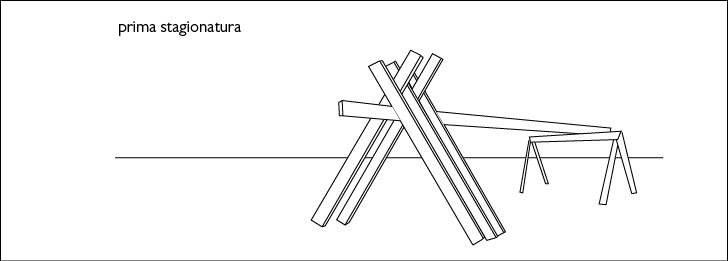
This can be done in two stages: first stand the boards upright, in an "x" or an inverted "v", in the open with no cover, to step up and speed the seasoning; then lay them flat so the air laps them as fully as possible.
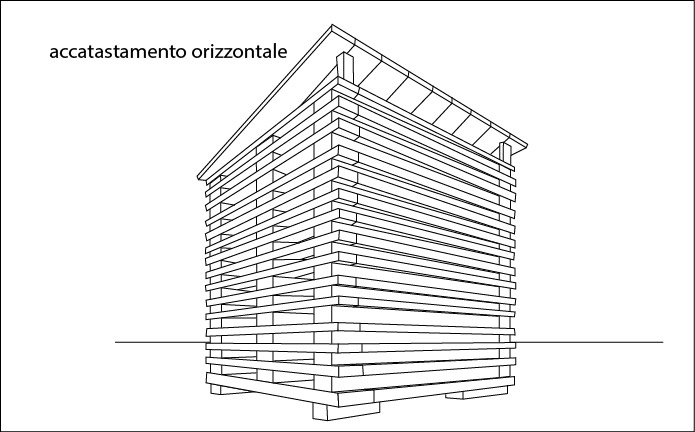
How long this takes varies — about 12 months per cm of thickness for hardwoods, and 6 months per cm for softwoods.
These figures are only rough guides. The method needs no special plant; the moisture leaves slowly and gently, so the timber works softer and more supple. It is a long process that ties up a lot of space and capital. Nor should we forget that timber left out this way easily falls prey to fungi, damp and fire, and needs its stacks periodically taken down and rebuilt. Not least, the final moisture content cannot be controlled to suit the intended use of the timber.