Italian Spruce — Picea Excelsa or Picea Abies

Val di Fiemme. See "Tonewood of resonance". This legendary wood is the one Stradivari used for his famous violins, and it is still the number-one choice for soundboards — hard to find and very expensive. Italian spruce has always been part of the Italian lutherie tradition and comes from the north, in the eastern Alps. The trees grow at high altitude, between 1400 m and 1800 m. With a growing season of just 100 days a year and very long, cold winters, they grow slowly and evenly. Boards for guitars call for trees 150 to 200 years old. The wood is very stiff and light: 400 kg/m3. On average these trees are smaller than the other spruces. Much research has gone into explaining scientifically why this spruce sounds so exceptional. Stiffness and lightness are obviously essential, but they are not the whole story: plenty of other woods have both yet do not match Italian spruce acoustically.
Sitka (Picea sitchensis)

Sitka spruce is the go-to topwood for guitar builders everywhere, chosen for its straight, even, uniform grain, its longevity and its tensile strength. Tonally it is extremely lively and offers an ideal template for transmitting sound on a stringed instrument of any size or type. Canadian Northwest & Alaska.
Bear Claw Sitka Spruce
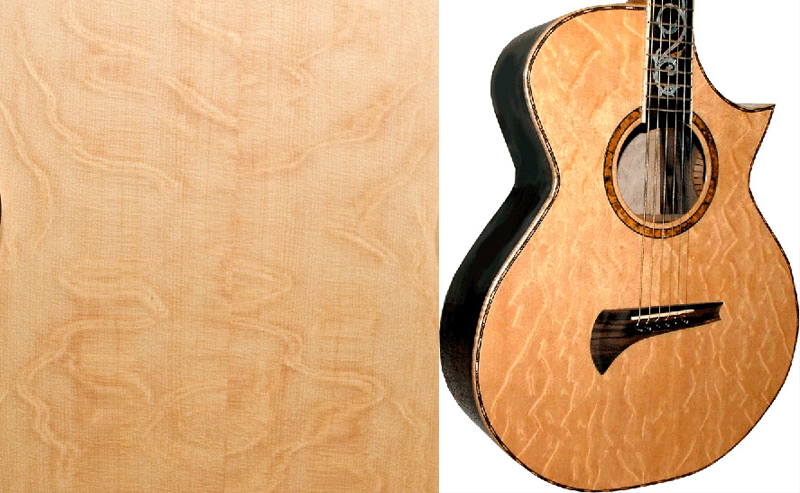
A particular variety of Sitka spruce. Whether through genetics or environment, it develops distinctive figuring — as if a bear had raked it with its claws, leaving marks across the grain. This variety is much sought after for its unique patterns. From the Pacific Northwest.
Engelmann Spruce (Picea Engelmannii)

Engelmann spruce is prized for its colour, close to the European (German) spruce. Besides being extremely light, this white spruce seems to give a stronger, more open sound than Sitka. It grows at alpine altitudes in the American Rockies, and is far less available than Sitka.
Adirondack (red) Spruce

This legendary wood, used by Martin & Co. for their tops in the golden years, grows on the east coast south of the New England mountains, above New York State. Known as both Appalachian and Adirondack spruce, it is a creamy white. Like Sitka it has a very good sound response — indeed with greater overall resonance. Interesting colour variation in the grain makes it a much-wanted tonewood. Adirondack has been unavailable since the mid-1940s. The original growths are, happily, preserved in national parks; the rest is all second growth — plentiful, but reaching only 18–19 metres, too small for guitar boards.
Carpathian/Ukrainian Spruce

From the Caucasus and the Carpathians around the Black Sea. This creamy-white wood has a slightly wider grain than the other European spruces. The boards are quite stiff and sound brighter than the European spruces. Many have likened it to Adirondack, and some even call it "Carpathian red spruce". It is a little cheaper than the other spruces and widely available.
German Spruce — Picea excelsa, P. abies (Europe)
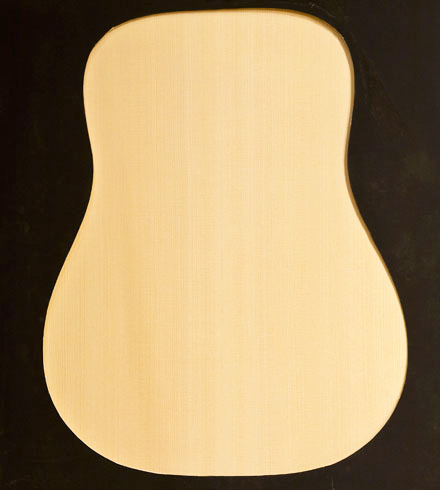
The most ringing of the red spruces. Very pale, it has all the versatility of a spruce and gives a very clean sound. "German spruce" is the common name for all spruce out of Europe, but the best now grows in the former Yugoslavia. It is used in acoustic guitars, but above all in classical guitars such as Ramirez.
Redwood

Chosen above all by fingerstyle players. It answers a light touch perfectly with a crisp, balanced sound, much like cedar but with more powerful bass — full and round. It does not bond perfectly with finishes and glues, and many luthiers recommend using it with "light" string sets. Native to Northern California.
Western Red Cedar (Thuja plicata)
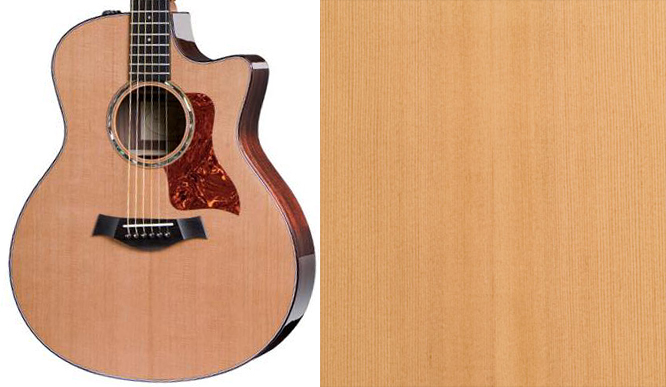
United States, particularly the Pacific Northwest. Western red cedar has long been used for classical guitar soundboards for its liveliness and clarity. It is extremely light next to red spruce, and the result is generally a touch louder — an open, balanced sound, rich in the trebles. One quirk of red cedar is that it looks worn even when new. Reddish in colour.
Port Orford Cedar (Chamaecyparis Lawsoniana)

Similar in look and scent to Alaska yellow cedar, Port Orford Cedar is stiffer and lighter, and so better suited to soundboards. It is much sought after for the robustness and the responsive tone it gives an instrument. Highly figured, gold-white, with tight grain. A great advantage for the luthier is that it resists cracking better than any other soundboard wood. It is not actually a true cedar — it has the peppery smell of the cypresses. An excellent choice for classical and acoustic instruments; luthiers such as Greg Byers, James Goodall and Les Stansell have had great results with it.
Alaskan Yellow Cedar (Chamaecyparis nootkatensis)

Alaskan Yellow Cedar, which some call Canadian cypress, belongs to a genus so close to the true cypresses that botanists once classed it among them. It is one of the most dimensionally stable woods under humidity swings, and so more crack-resistant than most (Port Orford Cedar aside). Tonally it suits flatpicking on acoustic guitars when you want a strong tone with a bright attack (its specific weight is close to Sitka and Adirondack spruce). Some classical and flamenco builders pick it out for a clear, articulate sound with great sustain.
Western Larch (Larix Occidentalis)
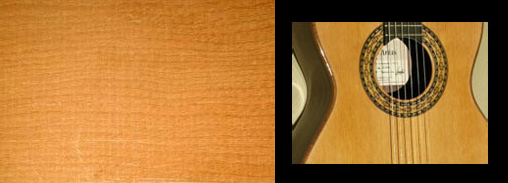
From the United States. Western larch adds one ring a year, giving very uniform grain. It is harder and stronger than most conifers, red spruce included. It looks much like Sitka spruce, and its extra stiffness suits models with "scalloped bracing", giving a projecting, snappy response.
Hawaiian Koa (Acacia Koa)
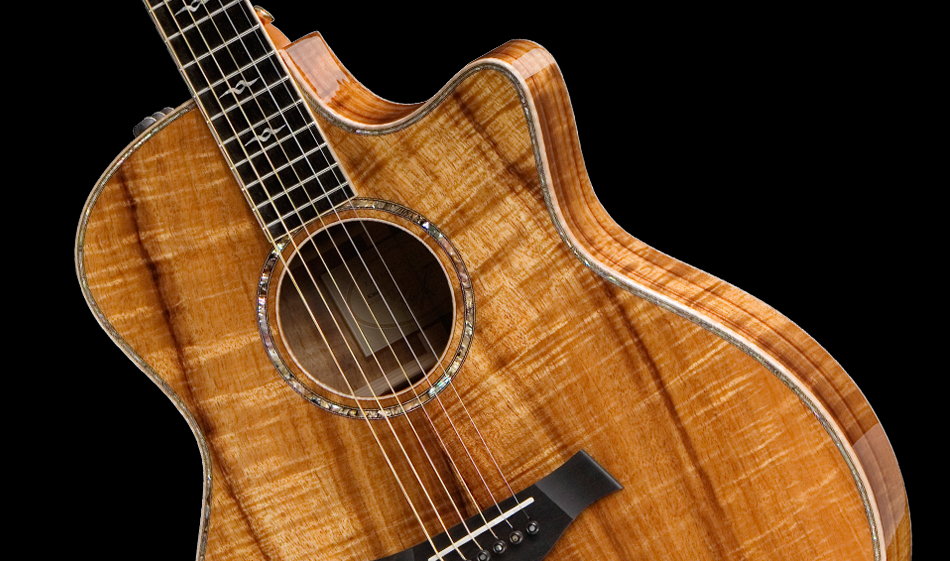
From Hawaii. Historically the koa top turned up mainly on smaller instruments — Hawaiian 0 and 00 guitars and ukuleles — though lately it has appeared on custom Dreadnoughts. Koa gives a mainly bright response in the highs, with less volume than red spruce, but the slight loss in volume is outshone by the sheer beauty of the figuring. Koa is used chiefly on "limited" models or custom builds.
Genuine Mahogany (Swietenia Macrophylla)
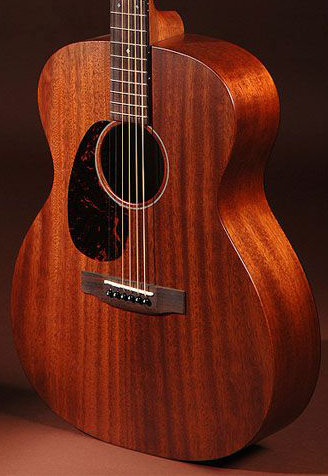
From Central America (Honduras, Mexico, Cuba, Guatemala, Brazil). Mahogany came in as a topwood in 1922 on the cheaper Style 17 guitars. Tonally it projects less than red spruce, giving a clean, delicate response with the emphasis on the midrange. The mahogany top is often available only on custom instruments, but lately it has become standard on smaller travel guitars.
Walnut

Breedlove were the first to use the highly figured walnut top, but other builders now offer it too. On top of a very rich, warm bass, it gives a clear, ringing sound in the mids and trebles. The walnut top is usually paired with back and sides of the same wood. It has a striking look, much like koa, but at a far more accessible price. Dark brown in colour, with plenty of figure.