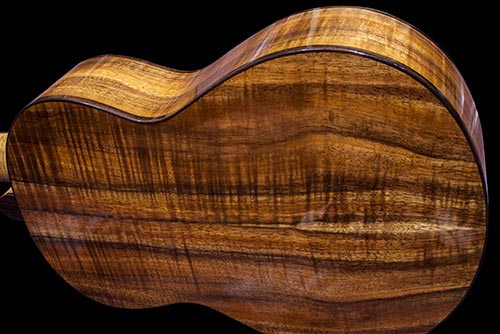
Common name: Koa — Scientific name: Acacia Koa — Country of origin: Hawaii
In this article we will go through everything that defines this wood and see why, in my view, it ranks among the very best for building ukuleles — and more.
Wood technology
- Weight: 610 kg/m3
- MOR (modulus of rupture): 12,620 lbf/in2
- MOE (modulus of elasticity): 1,503,000 lbf/in2
Both values are expressed in pounds-force per square inch.
The MOR tells us how much force the wood can take before it breaks — its strength. The MOE tells us its elasticity, that is, how much it deflects: essentially the ratio between the load applied and the resulting deformation. Elasticity can also be given in GPa (gigapascals). All values assume a moisture equilibrium of 12%.
Volumetric shrinkage: 12.4%. This is how much the wood shrinks in volume as it goes from "green" to seasoned, and it is a good guide to how stable the wood will be as the ambient humidity changes.
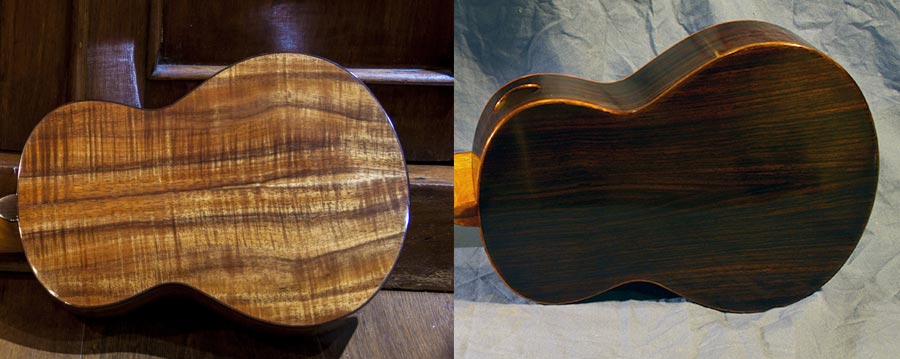
To make sense of these figures, let us set them against a more familiar, widely used wood and draw a few conclusions — comparing koa with another first-rate tonewood.
Koa:
- Weight: 610 kg/m3
- MOR: 12,620 lbf/in2
- MOE: 1,503,000 lbf/in2 - 10.37 GPa
- Shrinkage: 12%
Indian rosewood (Dalbergia latifolia):
- Weight: 830 kg/m3
- MOR: 16,590 lbf/in2
- MOE: 1,668,000 lbf/in2 - 11.50 GPa
- Shrinkage: 8.5%
Koa is much lighter and more elastic (for perspective, steel has a MOE of 200 GPa, while a wood tops out at around 7 GPa), breaks at a lower load, and is more sensitive to changes in humidity. Technically, then, koa is remarkably light yet still holds on to excellent stability, hardness and strength.
Sustainability
One very important point is species conservation. Koa grows in the Hawaiian Islands and is not at risk of extinction (not listed under CITES), thanks to the way it is managed: only trees at the end of their life cycle are harvested, and reforestation is ongoing.
Aesthetics

Its looks are one of a kind. The figuring can be extraordinary — the best cuts show horizontal curl to rival the finest curly maple. Very often, once finished, it turns iridescent, its colours shifting with the angle of the light. Aesthetically, among the very best there is.
Tone
Koa's tonal qualities are nothing short of excellent. It has a very deep voice capable of wonderfully interesting tone colours, a round timbre that brings out the mid and high frequencies, and an excellent response overall. I have also seen for myself how it improves tonally over time — a trait fairly common to the finest woods.
In lutherie

Koa takes very well to scrapers and chisels and bends fairly easily. Now and then you run into trouble where interlocked grain leaves patches prone to chipping.
Its dust is no more toxic than ordinary wood dust; in fact koa is free of the allergic reactions triggered by many tropical woods and rosewoods.
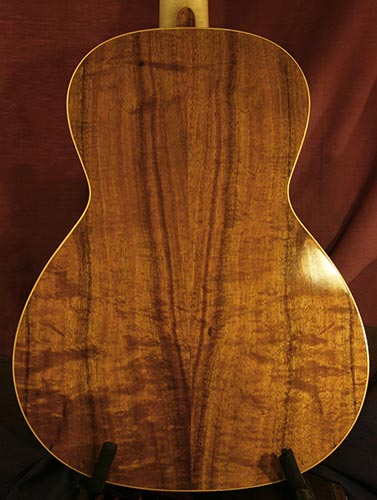
Its uses in ukulele making are wide-ranging. Its technical, tonal and visual qualities make koa suitable for almost every part of the instrument. It is certainly excellent for back, sides and soundboard, and beautifully suited to bindings and inlays. It even shows up in some quality tuners as the "button" — a job usually given to ebony.

Recently I have also tried it for fretboards on tenor ukuleles, and the result was outstanding. Its hardness and beauty make it a natural fit, but the real bonus is its lightness: it helps balance the instrument far better.
On a ukulele, weight balance matters more than you might expect, since in most cases the player holds it with nothing but their grip, without a strap. The imbalance usually pulls to the left (for right-handed players), where the tuners, the headstock and the whole neck sit.

Price
Price is a deciding factor for many, but to my mind it is fair for the quality. Its high cost is partly down to its origin being limited to the Hawaiian Islands. It is also worth noting that koa sets, like those of other woods, come in various grades of cut — AAAAA+ (master grade), 4A, 3A, 2A... — and the price can run from 100 to 500 dollars depending, too, on the size of instrument they are meant for.
Conclusions

Its beauty, its lightness, hardness and strength, and its tonal qualities make koa, in my opinion, the best choice for building a ukulele.
A word of warning: when a "koa" ukulele is going cheap, ask yourself whether it really is koa. There are around ten species of acacia, and some look "vaguely" like the lower grades of koa — but only on the surface, with very different technical properties.