Compensation in fretted string instruments
The quality of a fretted string instrument comes down to several things. One of the most important is how well it stays acceptably in tune all the way up the fretboard. In this article I will not lay out mathematical formulas (partly because I would not be able to); instead, far more simply, I will describe how I tackle this problem in practice. All of it applies to any fretted string instrument.
Equal Temperament — Scale length

The musical scale laid out on a string instrument's fretboard is built on "Equal Temperament" (for the history and the science, see this link: Equal temperament). It divides the octave into twelve equal parts, or semitones — "equal" here meaning the ratio between frequencies.
In short, these are mathematical formulas that, for a given scale length, let us work out the distance of each fret from the nut and the spacing between one fret and the next.
The position of the fretboard and the bridge
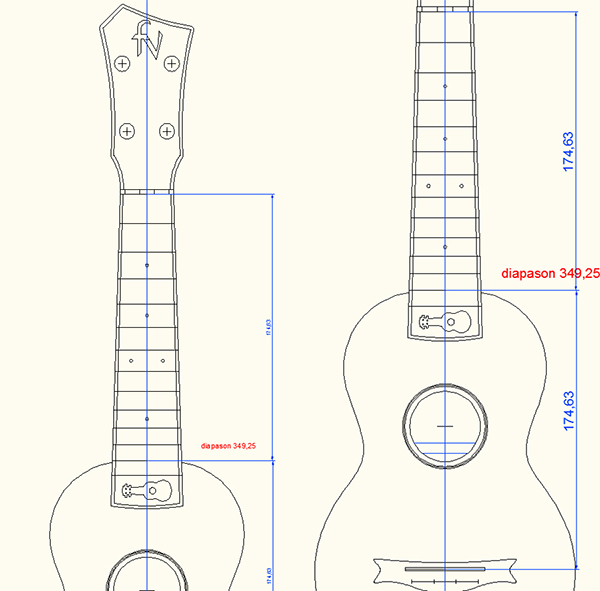
Personally, I prefer to glue the fretboard on after the neck has been joined to the body. The fretboard obviously has to sit dead centre on the neck, so that the axis of the instrument meets the frets at 90°. For appearance's sake, the 12th or 14th fret (depending on the instrument) is usually made to line up exactly with the neck-to-body joint. Between the headstock and the fretboard, room is left for the nut (4–5 mm).
The octave, marked by the first twelve frets, is exactly half the scale length. That is my starting point for placing the bridge. The bone saddle — my second anchor point — therefore has to sit so that its distance from the nut equals the instrument's scale length plus a little extra, called compensation.
Compensation
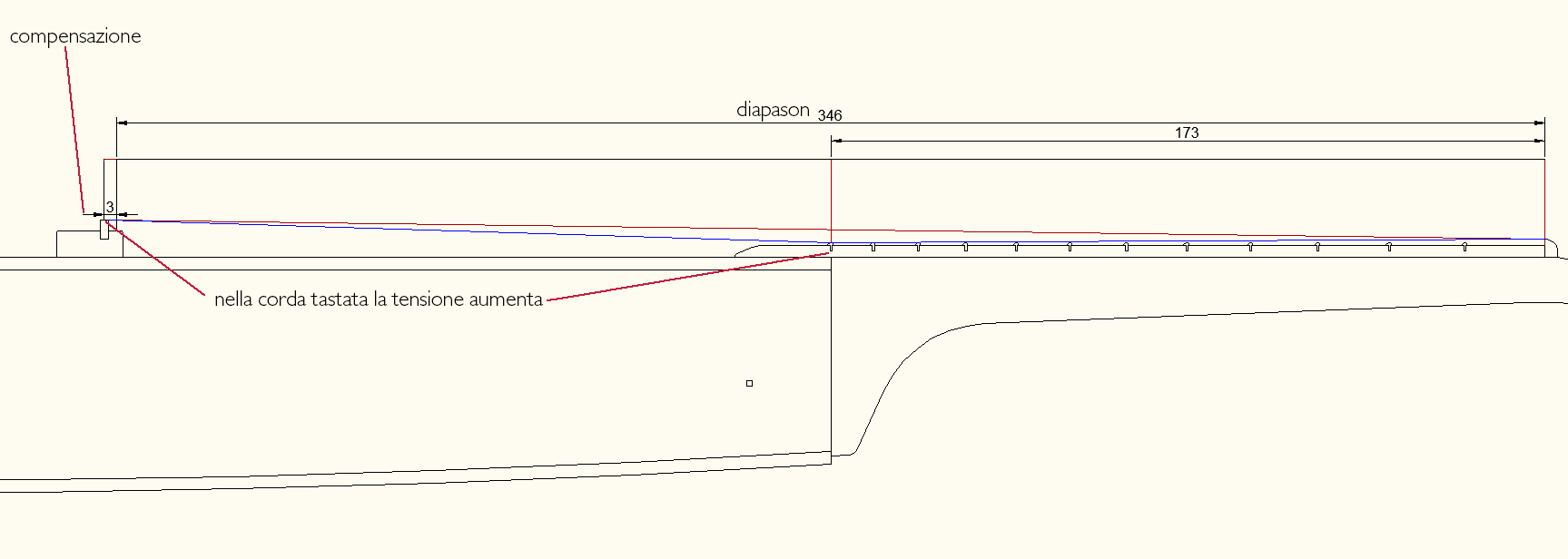
This is something that probably few people know about, yet it has to be dealt with whenever we talk about the intonation of a fretted string instrument. How much you add to the scale length depends on several factors: the action (the gap between string and fret), the gauge of the string, and how much tension it is under.
Essentially, the problem is a change in string tension when you fret a note. To reach the fret, the string has to stretch slightly, which raises its tension a touch and so sharpens it slightly. For example, playing the 3rd string of a ukulele open gives you a "C"; fret it at the 12th and you should get the C an octave up, but it will sit a little sharp precisely because the string is now under greater tension. The higher the action, the bigger the error. To fix this, the bridge is set back by an amount that compensates for the effect. That amount also grows with the tension (in kg) on the string and with its gauge. On a ukulele too, each string has its own gauge, which is why the final compensation adjustments are made at the saddle, shifting the string's contact point forward or back.
On a ukulele it can be around 1.5 mm up to 3 mm; on an acoustic guitar even double that; and up to 9–10 mm on an acoustic bass. With metal strings the difference in compensation from one string to the next is easy to see. That is also why electric guitars have a bridge mechanism that lets you set each string's compensation with a screw, strings on. For the same reason, an acoustic guitar's saddle is set at a slight angle, with the bass side further back. The test of correct (acceptable) intonation is getting the string fretted at the 12th to match its harmonic in unison. Calculating that extra amount exactly at the design stage is all but impossible: even knowing the factors above, we could never pin down an exact figure — other things get in the way, such as how hard the player presses the string — but experience certainly helps us estimate it well enough.