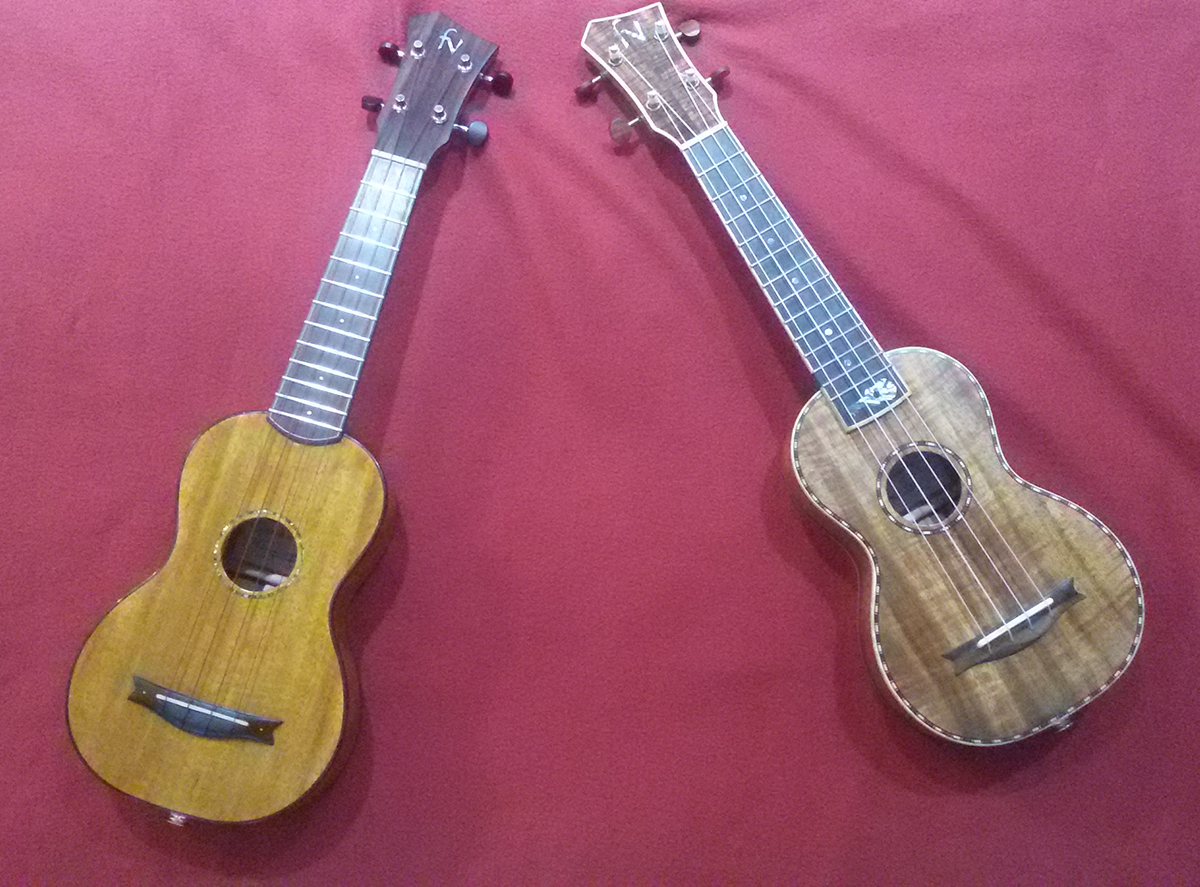
If this were a beauty contest, it would be no contest at all. But what if we judged it by sound instead?
We are talking about two very noble, highly prized species.
The mahogany I mean is the one that grows from southern Mexico down into the heart of South America — so-called Honduras Mahogany (Swietenia macrophylla). It differs from African Mahogany (Khaya anthotheca) in several respects:
Weight: African mahogany 640 kg/m3 ; Honduras mahogany 590 kg/m3
Strength and elasticity are fairly close, though the Honduras is more elastic while breaking at a lower load.
African M.: MOR (modulus of rupture) 13,190 lbf/in2 (pounds-force per square inch) — MOE (modulus of elasticity) 1,537,000 lbf/in2 Honduras M.: MOR 11,710 lbf/in2 — MOE 1,458,000 lbf/in2
Source: wood-database
Sorry for all the figures, but I have read and heard the strangest things about these two woods... The Khaya's one advantage is that it costs far less.
As I was saying, aesthetically Koa (Acacia Koa) wins hands down. Its figuring is stunning, and once brought to final finish it reveals curls that shift with the angle of the light. Spectacular! But once we talk about tone, the "contest" between the two woods gets far more interesting.
Mahogany has a fast, bright response and a leaner voice that produces an exceptionally clear, "clean" sound. It suits "classic" ukulele players who love swing, jazz and blues — all the sounds that carry us back to the American roots of the instrument. Think of the woods Martin used in the 1940s.
Koa has a rounder, more complex sound, with a deep, forward voice and rich, intriguing harmonics. An introspective sound. It probably takes us back to the ukulele's original Hawaiian roots. To my ear it fits genres like reggae, rock and pop.
The bottom line: real mahogany has nothing to be ashamed of next to the far pricier, undeniably beautiful koa. Everything here is relative and personal, even if I do believe some of it is objective. In the end, your own taste and feel are the only guide worth following.