How dry does wood have to be to be used in lutherie? And what ambient humidity should it be kept in? This article sets out to answer those questions.
One thing you can never afford to overlook when working wood, in lutherie and beyond, is how much moisture it holds while an instrument is being built. We will call it MC% (moisture content).
Wood is hygroscopic: by its nature it takes up or gives off moisture according to its surroundings, and so it swells or shrinks. For that reason its moisture level cannot be ignored in any kind of production, least of all instrument building. Using wood that is not "seasoned" is, in most cases, what causes the unwanted movement that undoes work already done.
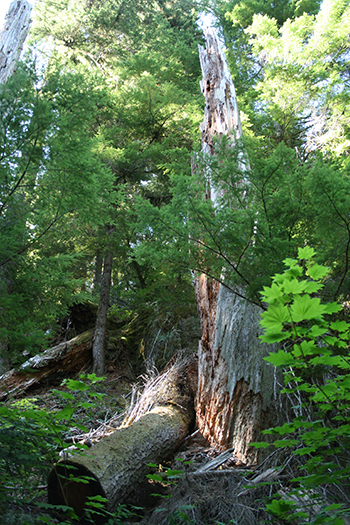
The moment just after the tree is felled — green wood — is taken as the maximum moisture level.
Wood holds moisture in two forms: as "free water" in the pores and vessels, and as "bound water" held in the cell walls. Once cut and exposed to air, wood starts to lose the free water. It does not yet change shape or size, since it is still saturated with bound water. When all the free water is gone, it has reached what is called the "fibre saturation point".
As time goes on, the wood begins to lose the bound water too, and once it drops below the saturation point it starts to change shape and volume. From here it enters the drying process. During drying it will not lose all of the bound water; how much it loses depends on the temperature and humidity around it. So we can say the loss of bound water is directly proportional to the relative humidity of the environment (RH%). To finish drying completely you need a kiln (0% relative humidity): under those conditions the wood loses all its water and we call it "dry".
The moisture content (MC%) of a piece of wood is the ratio between the weight of the water it holds and the weight of the "dry" wood, given as a percentage. In some species the water in freshly cut wood can weigh more than the wood fibres themselves, which puts the MC above 100%.
I have laid this out purely to explain the "seasoning" of wood, and to make sense of why a digital moisture meter can read above 100%.
In many species the fibre saturation point can be taken as around 30% MC. Bear in mind it is not reached evenly: a gradient forms from the outside in, with the core staying wetter. That is why it is better to let lutherie woods dry already cut and split into thin boards, which makes the seasoning quicker and more even.
During seasoning the moisture content falls below the fibre saturation value (about 30% MC) until it reaches an equilibrium point that shifts with the temperature and relative humidity of the surroundings.
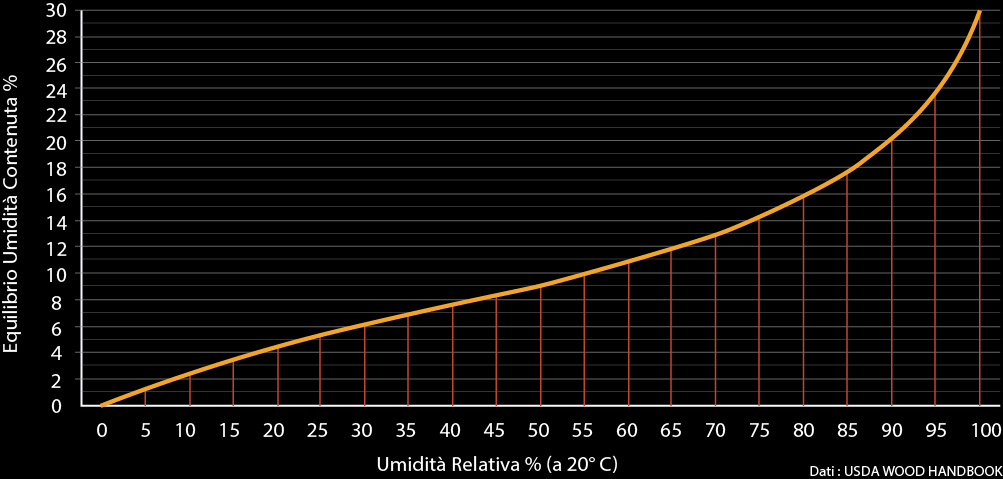
To grasp moisture in wood, keep in mind the relationship between the equilibrium point and the relative humidity the wood is exposed to. The graph shows how it behaves.
Once wood reaches 30% MC there is no going back, since all the free water has been lost and cannot be recovered by any means.
As the graph shows, the curve does not rise smoothly or evenly: it is slightly flatter at RH levels between 25% and 50%, meaning the changes in volume across that range are very small. At the two extremes, on the other hand — from 0% to 20% RH and from 85% to 100% RH — the curve climbs more steeply, which means more pronounced shrinkage (even to the point of cracking) in the first case and swelling in the second.
A temperature of around 20°C has been assumed; at equal humidity, temperature (between 0° and 40°C) plays only a minor role, worth about 1% of MC either way.
Conclusions
For exactly the reasons above, it is clear that building instruments calls for wood that has reached its equilibrium point — stable, and no longer subject to noticeable change.
Given that the most common relative humidity in indoor spaces — where the instrument will mostly be kept and played — falls somewhere between 45% and 65% RH, we can say the best conditions sit within an equilibrium moisture point of 8% to 12%.